


The List Is Dead. The Operation Begins.
Mythos didn’t create the problem of vulnerabilities outpacing patches, it made the problem impossible to ignore. When offense has no speed limit, the list-based model of security doesn’t just slow down. It collapses entirely. Not because the list was poorly built, but because the list was never the right unit of work.
There is a harder truth underneath the Mythos announcement that the industry needs to confront directly: Vulnerability Management was never designed to prevent breaches. It was designed to demonstrate due diligence.
The entire Vulnerability Management model — scan, score, prioritize, report, patch is built around satisfying an auditor, not stopping an attacker. You can be 100% compliant on your KEV remediation SLAs, 100% green on your vulnerability dashboard, and still get breached the same afternoon. Because the attacker used a chained path your controls didn’t cover, against an asset your inventory didn’t track, through a vector your compensating controls didn’t block. Compliance was achieved. The breach happened anyway.
Nearly every major breach of the last five years happened to organizations with mature Vulnerability Management programs. The model doesn’t fail because teams aren’t trying hard enough. It fails because it asks the wrong question. Vulnerability Management measures the presence of findings and patching rate. What actually determines breach is reachability, exploitability in context, and whether your controls are actually functioning. Those are different questions entirely, and Vulnerability Management doesn’t ask them.
Mythos doesn’t accelerate the problem Vulnerability Management was built to solve. It exposes the problem Vulnerability Management was built to ignore.
The right unit of work is an operation. Specifically, an exposure operation, a continuous, closed-loop process that detects exploitable conditions in your specific environment, validates them in full context, neutralizes them before exploitation, and never stops asking whether the environment has changed.
The Breaking Point: Why You Must Change Today
The KEV Reality Check
The CISA Known Exploited Vulnerabilities (KEV) catalog, the industry’s gold standard for confirmed in-the-wild exploitation, ended 2025 at approximately 1,500 entries, growing by 245 additions in 2025 alone, more than 30% above the trend of prior years. That growth was built entirely on human-speed vulnerability discovery: researchers, bug bounty hunters, incident responders piecing together exploitation evidence after the fact.
Now apply Mythos math.
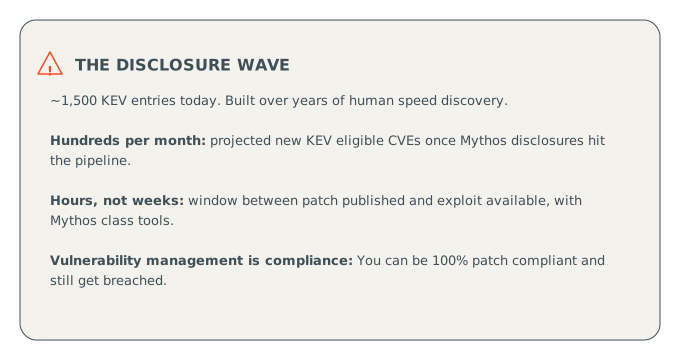
Mythos Preview autonomously found thousands of zero-day vulnerabilities across every major OS and browser in weeks. Each is responsibly disclosed, gets patched, and the patch commit becomes public. Every upstream commit is a signal. Every published patch is a roadmap. With Mythos-class tools converting a known vulnerability plus its patch into a working exploit in under a day, at under $2,000, with zero human intervention: the window between ‘patch published’ and ‘exploit available’ has collapsed from weeks to hours.
The cascade is unforgiving: when Mythos disclosures hit the pipeline, we go from ~20 KEV-eligible additions per week to potentially hundreds per month. That is a 10× volume shock to an infrastructure that took three years to reach 1,500 total entries. KEV becomes inactionable as a prioritization tool. EPSS scores lag, trained on historical patterns with no signal on newly disclosed zero days. Patch SLAs become fiction. The CVE system itself may not scale to AI-generated discovery rates.
The Moment of Choice
This is not a future risk. The first Glasswing patches are already landing, and this wave is only the first. Mythos-class capabilities will be released broadly once safeguards mature. Competing models from other labs, including some that will not apply the same restraint, are months behind. Open-weight models with comparable capabilities are likely going to be available within a year.
Organizations that do not change their operating model before this wave hits will break under it. Not because their teams aren’t capable, but because the model they’re running was built for a world where discoveries come in dozens per month and exploits take weeks to develop. That world ended on April 7, 2026.
The organizations that survive will be those that already built the muscle: continuous exposure detection, compensating control validation, AI-speed response, and a closed loop that verifies closure rather than trusting ticket status. That infrastructure takes time to build. The window to build it before the second wave arrives is measured in weeks, not quarters.
The Ten Disciplines of Exposure Detection & Response
The model has ten disciplines. Together they constitute Exposure Detection & Response, the framework that makes a security team Mythos-ready. This is not a rebranding of vulnerability management; it is a fundamentally different operating model.
- Detection: Find Exploitable Conditions, Not Generic Findings: The question is never, ‘does this vulnerability exist somewhere?’ It is, ‘do the exploitable conditions for this vulnerability exist in this environment, on this asset, right now?’ A CVE in a library you don’t run is noise. The same CVE in a library on an internet-facing server with no compensating control is an emergency. Detection means continuously scanning for the combination of conditions that makes exploitation feasible.
- Compensating Controls: Your First Line of Defense Must Actually Be Defending: The existence of a control is not the same as the effectiveness of a control. Your EDR covers 94% of endpoints; the missing 6% is your most critical servers. Your firewall rule was correct three weeks ago. The compensating control check must happen for every specific exploit path, not as a generic coverage metric: given how this CVE is actually exploited, does the control blocking it actually block it right now?
- Business Impact: Assume Exploit Then Trace the Blast Radius: Generic impact scores are operationally useless. The discipline here is assumed exploitation with specific blast radius tracing. It’s not abstract severity, but a case-by-case analysis: what credentials does the attacker gain, what lateral movement paths are open, which business processes go offline, which regulatory obligations trigger? This changes, ‘We have 1,400 critical findings’ into, ‘We have three exposures that would halt payment processing in 20 minutes.’
- Forensic Context: Static Data Is Not Enough: The exposure picture at 9 AM is not the picture at 2 PM. Is the vulnerable process actually running, not just installed, running? Is the relevant inbound traffic reaching this asset? What credentials would the attacker gain, and where do they have access? This forensic layer separates a theoretical exposure from an operational one. Static inventories and periodic scans cannot close that gap.
- Response: Neutralization First, Patching Second: The patch cycle is going to break. The disclosure wave hasn’t fully hit yet, and enterprise patch deployment windows measured in months are already incompatible with exploit-ready timelines measured in hours. The response discipline must be rebuilt around neutralization as the primary action: block the traffic vector, isolate the asset, revoke the credential, and disable the vulnerable service with what you have, before the patch exists.
- SOC Feedback Loop: Is It Happening Right Now?: Exposure management and detection are two halves of the same operation. When the SOC sees a suspicious authentication or lateral movement indicator, the Exposure Ops team asks: Is this consistent with an exposure we know about? Which other assets are reachable by the same mechanism? Where is the next hop? A live exploitation alert is ground truth about attacker capability, and it must immediately feed back into the exposure model.
- Threat Intelligence: The Faster Attackers Move, the More Intel Matters: When Mythos-class capabilities proliferate to less responsible actors, and they will, within months for frontier models, threat intelligence becomes a real-time operational input. When a new exploit technique appears in the wild, the exposure team needs to know within hours which assets are exposed to that specific technique, in what configuration, with what compensating controls. Operationalized intel, not a background feed.
- Continuous Validation: Every Micro-Change Triggers Reassessment: “One-and-done” is not a security posture. Every micro-change in the exposure factors triggers a reassessment of the full scope: new exploit published, revalidate every affected asset. Compensating control degrades, revalidate every exposure that depended on it. Asset changes business criticality, revalidate its blast radius. In the Mythos era, where new disclosures may arrive daily and exploit code follows in hours, weekly validation is theater.
- Closed Loop: Trust Nothing Until Verified Closed: Tickets are intent. Remediation is a changed configuration, a patched binary, or a revoked credential verified by the system that identified the exposure. The Exposure Ops team never marks an exposure resolved based on ticket status. They verify it. Did the compensating control get deployed? Is the attack path actually broken? Under Mythos-speed timelines, an exposure ‘ticketed for remediation’ three weeks ago and not verified closed is an exposure the attacker already knows about.
- Multi-Team Collaboration: Own the Problem, Mobilize the Solution: The Exposure Ops team does not fix everything. They own the problem definition and accountability for closure. To mobilize another team effectively, they need three things: exact context of why the issue matters and how urgent it is, the exact action required (not a generic ‘please patch this’), and a track record of zero false positives. If the Exposure Ops team cries wolf once, they’ll lose the trust they need to mobilize fast when it counts. In a world where the response window is measured in hours, that trust is the operational foundation.
Why AI Is Not Optional — It Is the Operating Model
These ten disciplines describe a system of enormous complexity. Every exposure must be detected in real time, validated against dynamic forensic state, assessed for blast radius, checked against current control effectiveness, mapped to active threat intel, matched to a specific remediation path, mobilized to the right owner, and be verified as closed, continuously, across thousands of assets, in parallel, every time the environment changes.
We cannot outwork machine-speed threats. This is not a workflow that humans can run at the required speed. It is not a problem adding headcount solves.
AI is not a feature added to this operating model. AI is the operating model. It is what makes the detection discipline run continuously. It is what makes the validation discipline instantaneous. It is what makes the blast-radius analysis case-by-case rather than generic. It is what allows a team of five to operate with the coverage of fifty.
This is not automation reacting to rules. It is AI reasoning about risk, the same way a senior security engineer would, but continuously, across the entire environment, at the speed the threat now demands.
The Operating Model Shift
Mythos is not primarily a technology problem. It is an operating model problem. The organizations that will be hardened when Mythos-class capabilities proliferate are not the ones that bought a new tool. They are the ones that changed how they operate.
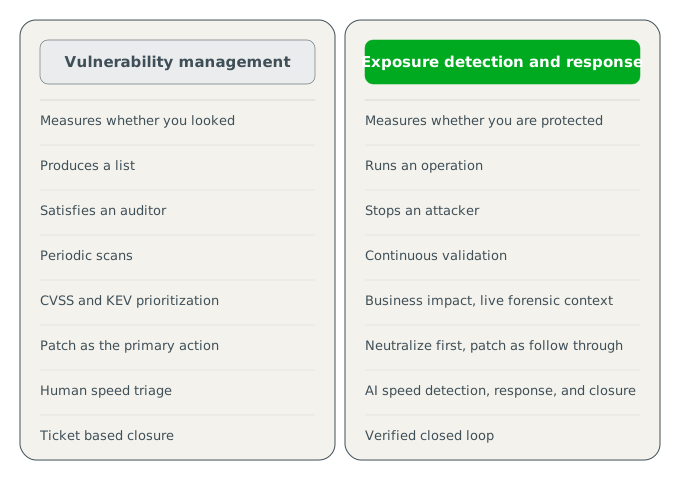
The window to make this change is not infinite. The first disclosure wave is already running. The second, from competitors less careful than Anthropic, from open-weight models available to anyone — is months away. The organizations that build Exposure Detection & Response into their operating model before that wave arrives will absorb it. The ones still running the list when it hits will break under it.
Every other approach is a faster version of what already exists. Exposure Detection & Response is a different thing entirely: a program built from first principles around the reality that offense now has no speed limit, and defense must
match it with an operational discipline that never stops, never trusts static data, never considers a finding closed until it is verified gone.
Don’t Wait for KEV. Know Before They Do.
Nagomi Security is the Agentic Exposure Ops Platform that turns the tools you already own into a coordinated defense. Nagomi unifies asset, control, vulnerability, and threat data into one view of real exposure, closing the gaps where risk hides. Autonomous agents investigate exploitable exposure 24/7, trigger precise remediation, and continuously verify that exposure stays eliminated. Recognized by Gartner as a Cool Vendor and a pioneer in Automated Security Control Assessment (ASCA), Nagomi helps organizations move from fragmented dashboards to defense effectiveness at scale.
See Nagomi in action at nagomisecurity.com