
back to blog
BLOG
RBVM vs CAASM vs Exposure Management: What’s the Difference and When You Need Each


RBVM ranks vulnerabilities by risk. CAASM consolidates asset inventory across tools. Agentic Exposure Ops eliminates the conditions attackers exploit. The three are often confused because they overlap in inputs, but they solve different problems and produce different outputs.
This post breaks down what each category does, where each one stops, and how to choose based on the gap you actually need to close.
Quick Answer: How RBVM, CAASM, and Agentic Exposure Ops Compare
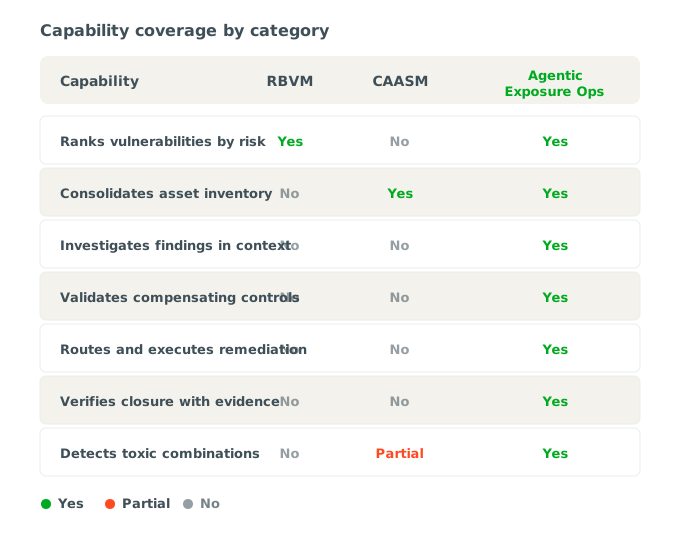
RBVM and CAASM both serve as input layers. Exposure Management is the operating layer that turns those inputs into closed findings.
What Is Risk Based Vulnerability Management (RBVM)?
Risk-Based Vulnerability Management (RBVM) discovers vulnerabilities and ranks them by risk score. It moves beyond raw CVSS by weighting factors like exploit availability, threat intelligence, and asset criticality. The output is a prioritized list of what to patch.
RBVM solves the prioritization problem inside vulnerability management. It does not solve exploitability, remediation routing, or verification. The list still has to be acted on by humans across consoles that were never built to talk to each other.
Common RBVM platforms: Qualys, Tenable, Rapid7. These are the category leaders in risk-based vulnerability management.
What Is CAASM?
Cyber Asset Attack Surface Management (CAASM) consolidates asset and exposure data from existing tools into a single queryable view. It pulls from EDR, cloud platforms, identity providers, vulnerability scanners, and CMDBs. The output is a unified asset inventory with exposure context.
CAASM solves the visibility problem. It tells you what you own, what’s misconfigured, and where coverage gaps exist. It does not investigate exploitability, route fixes, or confirm closure. Visibility is not progress.
What Is Agentic Exposure Ops?
Exposure Ops is a continuous operating model that detects, investigates, and eliminates live exposures before adversaries can exploit them. Agents evaluate every exposure signal as it emerges, vulnerabilities, attack surface changes, misconfigurations, identity gaps, and active threat intel, all correlated on a single asset view.
Instead of fragmented handoffs across SecOps, SOC, VM, and IT, every team works from the same exposure context with clear ownership, agentic action, and verified outcomes.
RBVM vs CAASM: What’s the Difference?
RBVM ranks vulnerabilities. CAASM ranks nothing. It catalogs.
RBVM answers the question: “Which vulnerabilities should we patch first?” CAASM answers the question: “What do we actually own, and what’s the state of it?”
The two are complementary, not competitive. RBVM is a vulnerability layer. CAASM is an asset and posture layer. Most enterprises run both. Neither one closes the loop. Both produce queues that humans still have to work through.
CAASM vs Exposure Management: What’s the Difference?
CAASM gives you visibility into assets and exposures. Exposure Management eliminates them.
CAASM is the inventory and visibility layer. Exposure Management is the operating layer that consumes inventory data and drives action. CAASM tells you what’s wrong. Exposure Management closes what’s wrong and proves the closure held.
A CAASM tool can show you that an asset has a failed EDR agent and a known exploitable vulnerability. It cannot route the fix, validate that compensating controls actually mitigate the risk, or verify that the regression has not returned. That is the work of Exposure Management.
RBVM vs Exposure Management: What’s the Difference?
RBVM ranks individual vulnerabilities. Exposure Management evaluates exposure conditions, including vulnerabilities, misconfigurations, coverage gaps, and toxic combinations.
RBVM gives a CVE a score. Exposure Management asks whether that CVE is actually exploitable given the controls deployed around the asset. If a WAF neutralizes the attack vector, the urgency drops. If the EDR agent is failed and the asset is internet-facing, a medium-severity CVE becomes urgent.
RBVM operates on findings. Exposure Management operates on conditions.
Why Teams Move Off Standalone RBVM and CAASM Tools
Three forces are pushing security leaders to look beyond standalone RBVM and CAASM tools.
The volume problem. RBVM platforms produce ranked lists. The lists are still longer than any team can act on. Triage, investigation, and routing remain manual. Analyst hours stack up against findings that never close.
The context problem. A vulnerability score calculated without compensating control validation is not a remediation decision. Teams patch what scores high and miss what’s actually exploitable. CAASM adds asset context but stops short of evaluating whether controls cover the exposure.
The verification problem. Tickets get closed. Fixes get assumed. Drift reopens attack paths that nobody resurveys. Without verified closure, exposure persists in plain sight.
The average enterprise runs more than 70 security tools. Each one scans, scores, and reports. Few correlate findings. Fewer act on them. RBVM and CAASM are part of that stack, not a solution to it.
When You Need an Alternative to a Traditional CAASM Platform
Consider an alternative when:
- Your CAASM platform provides inventory but not remediation
- Teams still manually correlate assets, exposures, controls, and threats
- Misconfigurations and identity risks remain disconnected from workflows
- You cannot validate whether fixes reduced exposure over time
- Security operations revolve around visibility instead of closure
Traditional CAASM platforms are built for aggregation and visibility. Agentic Exposure Operations platforms are built to investigate, prioritize, remediate, and verify exposure reduction continuously.
How to Choose: A Decision Framework
Choose RBVM if your gap is vulnerability prioritization and you have the human capacity to investigate, route, and verify across the rest of your stack.
Choose CAASM if your gap is asset visibility and you need a unified inventory before you can act on anything.
Choose Exposure Management if your gap is operational. You already have detection coverage. You need closure at scale, with verification.
Most mature security programs end up running all three layers. The shift is recognizing that detection and inventory are inputs, not outcomes. The outcome that matters is verified closure.
Where Agentic Exposure Ops Fits
Agentic Exposure Ops is the autonomous operating model for Exposure Management. AI agents run the full Detect, Investigate, Remediate, Verify loop across the existing security stack. No new workflows. No rip and replace.
Production deployments deliver:
- 4 minutes mean investigation time, down from hours of manual correlation
- 80 percent of triage eliminated as agents handle investigation autonomously
- 2 plus full-time analyst equivalents returned per year
- 879 hours of analyst time replaced annually per deployment
The metric is verified closure. Not alert volume. Not severity scores. Not ticket counts. Closure means exposure was remediated, the fix was effective, and the fix held under changing conditions.
Frequently Asked Questions
Is RBVM the same as vulnerability management? No. Traditional vulnerability management ranks by CVSS or severity. RBVM adds risk context like exploit availability, threat intelligence, and asset criticality. Both produce ranked lists. Neither closes findings.
Is CAASM the same as exposure management? No. CAASM is the asset and visibility layer that feeds exposure management. It tells you what you own and what’s misconfigured. It does not investigate exploitability, route fixes, or verify closure.
Do I still need CAASM if I have an Agentic Exposure Ops platform? No. A true Agentic Exposure Ops platform already includes the inventory and correlation foundation CAASM provides, but goes further by connecting assets, vulnerabilities, controls, identities, and threats to prioritize and drive remediation.
CAASM tells you what exists. Exposure Ops tells you what creates risk, what to fix first, and whether the fix actually worked.
Do I still need RBVM if I have an Exposure Ops platform? Most teams keep RBVM as an input layer. Exposure Ops consumes RBVM output and adds investigation, control validation, remediation routing, and verification on top.
What replaces traditional RBVM tools? Agentic Exposure Ops platforms do not replace RBVM scanners. They replace the manual operating model security teams use to act on RBVM output. The scanner stays. The closure work shifts to autonomous agents.
Is CTEM a product category or a methodology? CTEM is a methodology defined by Gartner. Exposure Management platforms are the product category that operationalizes CTEM in production environments.
What is verified closure? Verified closure means exposure was remediated, the fix was effective, and the fix held under changing conditions. It is the operational metric for risk reduction in Exposure Management.
What are toxic combinations? Toxic combinations are clusters of conditions that create real attack paths even when no single finding scores critical. Example: an internet-facing server with a failed EDR agent and a known exploitable vulnerability.
See Where Your Exposure Gap Stands
Most security programs have RBVM. Most have CAASM. Few have closure. Nagomi maps your current state across detection, investigation, remediation, and verification, and shows exactly where findings fall through.
Download the full Exposure Ops Guide for the complete capability matrix, the failure points in the loop, and the production benchmarks behind the numbers above.