Illusion of Maturity

Most security programs look healthy on paper while live attack paths stay open because controls fail together, not alone.

Overview

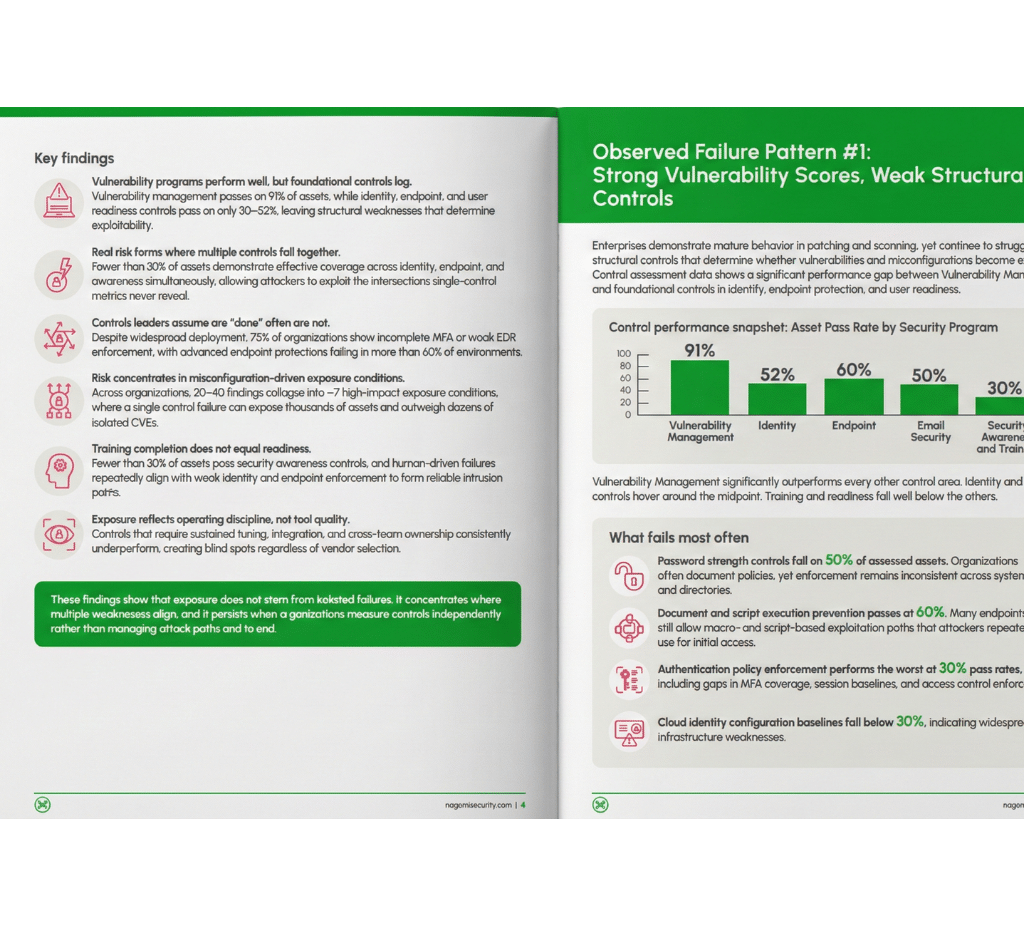
Security organizations did what they were told to do. They bought best-of-breed tools, deployed them broadly, and reported steady progress through clean dashboards and improving scores. Yet exposure persists because enforcement breaks down where controls intersect across identity, endpoint, configuration, and human behavior. Operational complexity, fragmented ownership, and inconsistent follow-through turn strong individual controls into weak collective defense. The result is not a lack of visibility or investment, but a failure to execute security as a coordinated system. Until exposure is managed where controls converge and attackers operate, maturity will remain a reporting illusion rather than a measurable reduction in risk.

%

of environments fail advanced endpoint protection tests.

%

of organizations show missing EDR coverage or weak or incomplete MFA enforcement.

%

of assets demonstrate effective coverage across identity, endpoint and awareness at the same time.

Five ways to close the execution gap.

See where risk actually forms

Surface convergent exposure where vulnerabilities, identity gaps, endpoint drift and user failures collide on the same asset.

Turn findings into owned work

Exposure conditions route to the teams that can fix them, with clear accountability across identity, endpoint, cloud and infrastructure.

Shrink attack paths, not dashboards

Measure progress by the number of high-blast-radius exposure conditions eliminated and assets removed from active attack paths.

Keep controls effective over time

Nagomi continuously checks enforcement so fixes don’t decay quietly weeks later as environments change.

Give leaders evidence they can use

Replace abstract scores with a simple view of exposure reduced, work completed, and risk that still remains.

Emanuel Salmona CEO

“Teams see the issues, but remediation slows down as work moves across tools, owners, and priorities. That operational latency leaves risk sitting in the environment far longer than it should. Real resilience comes from tightening operations and collapsing the time between seeing exposure and actually eliminating it.”